http://ozarksfirst.com/fulltext?nxd_id=743902
The link above is a local story on the conceal and carry bill that now includes a provision for teachers to bring concealed weapons to school. In my opinion, this is a reaction rather than a solution to the problems of violence in our schools and in our society in general.
It's interesting that some of the same legislators who are constantly undermining the teaching profession with half-baked "reform" bills now seek to arm the very folks who they like to characterize as incompetent and ineffective. One thing is consistent - these legislators continue to work in a vacuum and never consult with the folks who are on the ground doing the work with the children. Rather than arming teachers, how about supporting schools and teachers with adequate staffing and funding. Perhaps then, we could do more to help the troubled children, which would probably provide the best long-term protection of all.
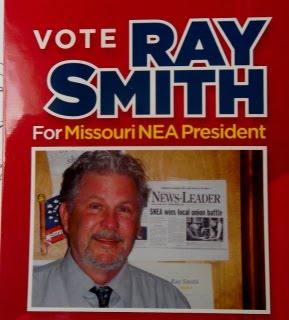
Campaign material paid for by the Committee to Elect Ray Smith - Michelle Shepard, Treasurer.
Thursday, December 20, 2012

Monday, November 5, 2012
Claire in Springfield

I had the honor to work some phones for Claire today. Tomorrow is the big day. Everybody I called today was a supporter, which was great to hear.
Thursday, November 1, 2012
Media Event - Support for Claire

Yesterday, I joined several retired teachers and UD, Sharon Swanson, at a Claire McCaskill media event next to Parkview High School in Springfield. You never know what you'll get at these events, but two radio stations and one TV station showed up - and the public radio piece aired on KSMU just as teachers were on their way to school this morning, which was great timing.
We tried to focus our remarks on Claire's support (and Akin's opposition) for the federal school lunch program. Springfield has a 53% free & reduced student population, up 15% over the past ten years.
Claire is in town today, and I'll be attending that event at noon. It's the stretch run, and we have to do all we can to support great candidates like Claire.
Here are links to a couple of stories from yesterday's event:
http://ksmu.org/article/springfield-teachers-rally-mccaskill-wednesday
http://ozarksfirst.com/fulltext?nxd_id=722482
Ray
Monday, October 22, 2012
Where am I?
To: Missouri NEA Friends & Supporters
I've heard comments from a couple of people in MNEA land that they haven't seen me much out on the campaign trail. There is one fundamental reason for this: I have a very busy full-time job as local president in our state's largest school district. As full-release president, I serve as the main advocate and representative for all our individual members and, on contractual issues, our local represents an 1,800-member bargaining unit. It's tremendously important and gratifying work, but it's very time consuming - and unfortunately, it does not provide me with the opportunity to travel the state campaigning within the context of my job.
The issues I'm dealing with on a daily basis - employee/employer relations, job actions, professional development, new teacher evaluations, teacher autonomy in the classroom, student discipline issues, administrative support for teachers, special education issues - are the same issues that are being addressed (or perhaps ignored) in your district.
One thing I'd like to clarify as a candidate: I did not enter this campaign as some kind of MNEA "insider", making promises or attempting to maintain the status quo based on perceived lines of succession. I'm actually working everyday with teachers, school secretaries, school nurses, paraprofessionals, MNEA staff and management, school administrators, union leaders, legislative candidates - you know, the people who work with students and teachers and in our communities - and advocate for public education. Without this kind of "on the ground" work, I wouldn't consider myself a suitable candidate for the position of Missouri NEA president.
I want to assure all MNEA leaders and delegates that, while most of my time is still focused on getting work done at the local level, I am excited about my campaign for MNEA president and have received some wonderful endorsements and contributions from members across the state.
I look forward to seeing all Missouri NEA delegates at the coming Rep Assembly and hope you will come by my campaign table to discuss my candidacy and the future of MNEA - and maybe pick up a button or two. We're not big on campaign bells and whistles, but I do enjoy a good conversation. Please come by . . . and on Friday night, my campaign will team up with several other great MNEA candidates for a big hospitality gathering down by the lake.
After the fall RA, the campaign begins in earnest, and I will be traveling the state as much as my work allows. I am most grateful for the support I've received to this point and hope to enlist more support at the RA. See you then!
Ray
I've heard comments from a couple of people in MNEA land that they haven't seen me much out on the campaign trail. There is one fundamental reason for this: I have a very busy full-time job as local president in our state's largest school district. As full-release president, I serve as the main advocate and representative for all our individual members and, on contractual issues, our local represents an 1,800-member bargaining unit. It's tremendously important and gratifying work, but it's very time consuming - and unfortunately, it does not provide me with the opportunity to travel the state campaigning within the context of my job.
The issues I'm dealing with on a daily basis - employee/employer relations, job actions, professional development, new teacher evaluations, teacher autonomy in the classroom, student discipline issues, administrative support for teachers, special education issues - are the same issues that are being addressed (or perhaps ignored) in your district.
One thing I'd like to clarify as a candidate: I did not enter this campaign as some kind of MNEA "insider", making promises or attempting to maintain the status quo based on perceived lines of succession. I'm actually working everyday with teachers, school secretaries, school nurses, paraprofessionals, MNEA staff and management, school administrators, union leaders, legislative candidates - you know, the people who work with students and teachers and in our communities - and advocate for public education. Without this kind of "on the ground" work, I wouldn't consider myself a suitable candidate for the position of Missouri NEA president.
I want to assure all MNEA leaders and delegates that, while most of my time is still focused on getting work done at the local level, I am excited about my campaign for MNEA president and have received some wonderful endorsements and contributions from members across the state.
I look forward to seeing all Missouri NEA delegates at the coming Rep Assembly and hope you will come by my campaign table to discuss my candidacy and the future of MNEA - and maybe pick up a button or two. We're not big on campaign bells and whistles, but I do enjoy a good conversation. Please come by . . . and on Friday night, my campaign will team up with several other great MNEA candidates for a big hospitality gathering down by the lake.
After the fall RA, the campaign begins in earnest, and I will be traveling the state as much as my work allows. I am most grateful for the support I've received to this point and hope to enlist more support at the RA. See you then!
Ray
Thursday, September 6, 2012
Leaving Behind NCLB
(The following is lifted from a recent Springfield NEA Blog post.)
Leaving Behind No Child Left Behind . . . Finally
Every school year brings its share of changes that affect education professionals, and 2012-13 rolls in with a fundamental shift away from some of the more damaging affects of the federal education law known as No Child Left Behind.
It should be noted that NEA lobbied the Obama Administration and was a key player in establishing language and key provisions in the waiver. It's far from perfect, but as the saying goes, "If you're not at the table, you could end up on the menu." There is no question that the provisions of the waiver are an improvement over the draconian measures that came with No Child Left Behind, but there is still much work to be done in monitoring and shaping how the waiver affects educators at all levels.
Springfield NEA, Missouri NEA and SPS administration were active participants in numerous MSIP5 developmental meetings over the past year and helped shape MSIP5 and Missouri's waiver application.
Missouri Granted ESEA Flexibility Waiver
On June 27, 2012, the Department of Education granted a waiver to Missouri regarding No Child Left Behind (formerly known as Elementary and Secondary Education Act). The Obama administration had placed a deadline for Congress to change and re-authorize the law, but - surprise!- nothing was done. So, an executive order was issued, and now over half the states have been granted waivers after submitting their plans to the Department of Education.
The ESEA Waiver was granted based on these required principles:
1) Adopt College and Career Ready Standards
2) State-developed differentiated recognition, accountability and support for school districts (MSIP5)
3) Develop and adopt guidelines for local teacher evaluation and support systems (Missouri Model Educator Evaluation), which will be piloted for 2 years, full implementation by 2014-15. Springfield is one of the pilot districts for new teacher evaluations this year. Springfield NEA will be collaborating with the district in developing this pilot evaluation and support system, which also includes an evaluation process for principles and the superintendent.
Here is a brief summary of some basic changes that come with the ESEA Waiver:
Instead of relying 100% on MAP status (advanced, proficient . . . etc.) as the lone criteria determining ranking of schools, MAP scores will be figured three ways: Status, Growth and Progress.
Status - This is pretty much the same old MAP snapshot approach we've come to know and love, but districts will also be able to use either Growth or Progress (whichever is more favorable) as a second measure that combines with Status to determine an overall score.
Growth - This factor compares the level of individual student growth (individual growth from last year's 3rd grade to this year's 4th grade).
Progress - This would compare grade level scores (how did this year's 4th graders compare with last year's 4th graders).
Based on a rather elaborate scoring system using a combination of the above, highest performing schools will be designated as Reward Schools (not sure of reward, but rest assured it won't be $). Lowest performing schools will be either Focus Schools or Priority Schools. There will be no penalty for schools that fall into these lower categories, but they will be the recipients of some kind of DESE oversite. And it remains to be seen how DESE will handle the increased work load in tracking over 500 districts, given the fact that budget cuts have rendered the state agency with what amounts to a skeleton staff.
Teacher Evaluation
The Missouri Model establishes four performance levels: New, Developing, Proficient, Distinguished. The model stresses that student performance must be included as a part of the evaluative process, but districts are provided flexibility in determining how this is done. This is why it is so important for the teachers to be at the table as this new system is formed, and that's why Springfield NEA has already met with district administrators to establish this precedent in the early stages. Springfield NEA will either issue our own surveys or work with the district to gather information from teachers regarding what they view as important measures - especially regarding student performance.
Missouri NEA has already worked with DESE to help "broaden" language regarding student achievement that was sent with the original waiver request. Missouri NEA also advocated against a state-determined weight of student performance - now it is a local decision. Springfield NEA, representing over 900 members in our district, will be an active participant in shaping the new system of evaluating educators at all levels.
Again, there is no additional funding from the feds or the state for the considerable amount of time and effort it will take for districts to establish these new evaluation systems.
Up Next
Up Next . . . feedback from teachers on the Springfield Learning Model, more information on Common Core State Standards, which take effect in 2014, and discussion on how the district determines "critical needs" when establishing budget priorities. Thanks for the wonderful work you do with students and for your support for Springfield NEA . . . it's completely mutual!
Ray Smith, President
Springfield NEA
Leaving Behind No Child Left Behind . . . Finally
Every school year brings its share of changes that affect education professionals, and 2012-13 rolls in with a fundamental shift away from some of the more damaging affects of the federal education law known as No Child Left Behind.
It should be noted that NEA lobbied the Obama Administration and was a key player in establishing language and key provisions in the waiver. It's far from perfect, but as the saying goes, "If you're not at the table, you could end up on the menu." There is no question that the provisions of the waiver are an improvement over the draconian measures that came with No Child Left Behind, but there is still much work to be done in monitoring and shaping how the waiver affects educators at all levels.
Springfield NEA, Missouri NEA and SPS administration were active participants in numerous MSIP5 developmental meetings over the past year and helped shape MSIP5 and Missouri's waiver application.
Missouri Granted ESEA Flexibility Waiver
On June 27, 2012, the Department of Education granted a waiver to Missouri regarding No Child Left Behind (formerly known as Elementary and Secondary Education Act). The Obama administration had placed a deadline for Congress to change and re-authorize the law, but - surprise!- nothing was done. So, an executive order was issued, and now over half the states have been granted waivers after submitting their plans to the Department of Education.
The ESEA Waiver was granted based on these required principles:
1) Adopt College and Career Ready Standards
2) State-developed differentiated recognition, accountability and support for school districts (MSIP5)
3) Develop and adopt guidelines for local teacher evaluation and support systems (Missouri Model Educator Evaluation), which will be piloted for 2 years, full implementation by 2014-15. Springfield is one of the pilot districts for new teacher evaluations this year. Springfield NEA will be collaborating with the district in developing this pilot evaluation and support system, which also includes an evaluation process for principles and the superintendent.
Here is a brief summary of some basic changes that come with the ESEA Waiver:
- Missouri schools will no longer be expected to reach 100% student proficiency goal by 2014.
- District are no longer required to reserve 20% of Title funds for Supplemental Education Services and school choice transportation.
- No more labeling of schools as "failing", no more letters sent to parents explaining that their child is attending a failing school.
- Schools missing one target will no longer be equated with schools missing several targets.
- Status of MAP scores no longer make up 100% of scoring measure.
- The "highly qualified teachers" component remains, but district penalty has been removed.
- Federal and State standards are not in conflict.
- The focus moves from punitive labeling to support for continuous improvement.
Instead of relying 100% on MAP status (advanced, proficient . . . etc.) as the lone criteria determining ranking of schools, MAP scores will be figured three ways: Status, Growth and Progress.
Status - This is pretty much the same old MAP snapshot approach we've come to know and love, but districts will also be able to use either Growth or Progress (whichever is more favorable) as a second measure that combines with Status to determine an overall score.
Growth - This factor compares the level of individual student growth (individual growth from last year's 3rd grade to this year's 4th grade).
Progress - This would compare grade level scores (how did this year's 4th graders compare with last year's 4th graders).
Based on a rather elaborate scoring system using a combination of the above, highest performing schools will be designated as Reward Schools (not sure of reward, but rest assured it won't be $). Lowest performing schools will be either Focus Schools or Priority Schools. There will be no penalty for schools that fall into these lower categories, but they will be the recipients of some kind of DESE oversite. And it remains to be seen how DESE will handle the increased work load in tracking over 500 districts, given the fact that budget cuts have rendered the state agency with what amounts to a skeleton staff.
Teacher Evaluation
The Missouri Model establishes four performance levels: New, Developing, Proficient, Distinguished. The model stresses that student performance must be included as a part of the evaluative process, but districts are provided flexibility in determining how this is done. This is why it is so important for the teachers to be at the table as this new system is formed, and that's why Springfield NEA has already met with district administrators to establish this precedent in the early stages. Springfield NEA will either issue our own surveys or work with the district to gather information from teachers regarding what they view as important measures - especially regarding student performance.
Missouri NEA has already worked with DESE to help "broaden" language regarding student achievement that was sent with the original waiver request. Missouri NEA also advocated against a state-determined weight of student performance - now it is a local decision. Springfield NEA, representing over 900 members in our district, will be an active participant in shaping the new system of evaluating educators at all levels.
Again, there is no additional funding from the feds or the state for the considerable amount of time and effort it will take for districts to establish these new evaluation systems.
Up Next
Up Next . . . feedback from teachers on the Springfield Learning Model, more information on Common Core State Standards, which take effect in 2014, and discussion on how the district determines "critical needs" when establishing budget priorities. Thanks for the wonderful work you do with students and for your support for Springfield NEA . . . it's completely mutual!
Ray Smith, President
Springfield NEA
Thursday, July 19, 2012
MNEA President Election, April 2013
Before hitting the campaign trail for SALT meetings in KC and St. Louis tomorrow, I have a couple of observations about the campaign and the election process in general.
Elections - Sign of Good Health
First, I would like to remind Missouri NEA members that the election for MNEA President at the Spring RA in 2013 will be to fill a vacant position. There is no incumbent running for MNEA President. Term limits prohibit our current president, Chris Guinther, from seeking a third term, and there is nothing in the by-laws that provides a line of succession to the office of president. Elections like this should be seen as a sign of good health, rather than some kind of affront to the institutional status quo.
Who Are We and What Do We Stand For?
Second, as one of our favorite school board members pointed out during the debate over teacher representation in Springfield, elections are about finding out what people want. It's as simple as that. And with each election in an organization like MNEA, we discuss our collective mission and vision as we move forward. Elections help define who we are and what we stand for, which is a good thing.
The Real Work Begins After the Campaign
I'm excited about running for the position of MNEA President. In Springfield, our local team battled against long odds for representation - in a very conservative region, during a terrible recession - and we won representation rights for teachers, school nurses and clerical staff. But those wins would be truly meaningful only if the bargaining process were proven to be effective. So, it could be said that the real work began the moment the election campaign was settled, and that is also the case with this election. The challenges and work ahead are significant. We cannot afford to become too distracted by the bells and whistles that come with campaigns like this. The new president will face a load of hard work even before officially taking office on August 1, 2013.
I'd like to thank all who have expressed their support for my candidacy from all areas of the state. Please pass this blog along to any MNEA members who are interested in the upcoming election. We'll all continue to move forward and have good conversations about what our association stands for and the work ahead. Together, we will make it work.
Elections - Sign of Good Health
First, I would like to remind Missouri NEA members that the election for MNEA President at the Spring RA in 2013 will be to fill a vacant position. There is no incumbent running for MNEA President. Term limits prohibit our current president, Chris Guinther, from seeking a third term, and there is nothing in the by-laws that provides a line of succession to the office of president. Elections like this should be seen as a sign of good health, rather than some kind of affront to the institutional status quo.
Who Are We and What Do We Stand For?
Second, as one of our favorite school board members pointed out during the debate over teacher representation in Springfield, elections are about finding out what people want. It's as simple as that. And with each election in an organization like MNEA, we discuss our collective mission and vision as we move forward. Elections help define who we are and what we stand for, which is a good thing.
The Real Work Begins After the Campaign
I'm excited about running for the position of MNEA President. In Springfield, our local team battled against long odds for representation - in a very conservative region, during a terrible recession - and we won representation rights for teachers, school nurses and clerical staff. But those wins would be truly meaningful only if the bargaining process were proven to be effective. So, it could be said that the real work began the moment the election campaign was settled, and that is also the case with this election. The challenges and work ahead are significant. We cannot afford to become too distracted by the bells and whistles that come with campaigns like this. The new president will face a load of hard work even before officially taking office on August 1, 2013.
I'd like to thank all who have expressed their support for my candidacy from all areas of the state. Please pass this blog along to any MNEA members who are interested in the upcoming election. We'll all continue to move forward and have good conversations about what our association stands for and the work ahead. Together, we will make it work.
Tuesday, June 26, 2012
Next Stop, D.C.
The end of the school year in Springfield is still dragging out, as our BOE still hasn't approved a budget for 2012-13, and ratified contracts for teachers, schools nurses, ESP and bus drivers have yet to be presented to the BOE. I don't remember a year in which a budget wasn't approved prior to the beginning of the new fiscal year, but it looks like a probability in Springfield this year.
After two sessions of impasse, Springfield NEA finally reached a tentative agreement with the district, and an unusual summertime ratification meeting was held at the MNEA/SNEA offices on June 19. Nearly sixty members attended, which wasn't a bad turnout considering that many were scattered far and wide for the summer. After a discussion of negotiations, proposals and counter-proposals, SNEA members voted 57-1 for ratification.
Our district is now attempting to manage an unexpected cut to Title I funding that amounts to around $1.2 million. Apparently, new poverty census numbers indicate that our district population is just as poor as it's suppose to be . . . at least that's my interpretation. While our free & reduced lunch population has blown past the tipping point of 50%, the rate of increase in poverty was actually lower than in other areas of the state. Thus, a cut in funding that affects some dozen Title I positions and a score or more para positions. Several SNEA members have called for clarification on their placement for next year. So far, it appears that everybody will be placed, but the affect on each school community is difficult to measure with these kinds of unexpected transfers.
Next, it's on to D.C. for the NEA Representative Assembly and, upon return, Summer Association Leadership Training sessions in Kansas City, Columbia, St. Louis and Springfield. By the time those are wrapped up, we're practically back in school, with new teacher induction events, building rep meetings, etc.
I guess all this just underlines how varied our work is with NEA. National, state and local issues are intertwined, which ultimately creates a strong core of support for schools, education professionals and the students we serve. It's also a reminder that my candidacy for MNEA president is actually secondary to the local work at hand. I agree with the new NEA emphasis on building local capacity. It's where our basic work is done and where we are closest to our underlying purpose as an association.
After two sessions of impasse, Springfield NEA finally reached a tentative agreement with the district, and an unusual summertime ratification meeting was held at the MNEA/SNEA offices on June 19. Nearly sixty members attended, which wasn't a bad turnout considering that many were scattered far and wide for the summer. After a discussion of negotiations, proposals and counter-proposals, SNEA members voted 57-1 for ratification.
Our district is now attempting to manage an unexpected cut to Title I funding that amounts to around $1.2 million. Apparently, new poverty census numbers indicate that our district population is just as poor as it's suppose to be . . . at least that's my interpretation. While our free & reduced lunch population has blown past the tipping point of 50%, the rate of increase in poverty was actually lower than in other areas of the state. Thus, a cut in funding that affects some dozen Title I positions and a score or more para positions. Several SNEA members have called for clarification on their placement for next year. So far, it appears that everybody will be placed, but the affect on each school community is difficult to measure with these kinds of unexpected transfers.
Next, it's on to D.C. for the NEA Representative Assembly and, upon return, Summer Association Leadership Training sessions in Kansas City, Columbia, St. Louis and Springfield. By the time those are wrapped up, we're practically back in school, with new teacher induction events, building rep meetings, etc.
I guess all this just underlines how varied our work is with NEA. National, state and local issues are intertwined, which ultimately creates a strong core of support for schools, education professionals and the students we serve. It's also a reminder that my candidacy for MNEA president is actually secondary to the local work at hand. I agree with the new NEA emphasis on building local capacity. It's where our basic work is done and where we are closest to our underlying purpose as an association.
Friday, June 1, 2012
FAQ: Why Are You Running for MNEA President?
Why Are You Running?
It's a great question, maybe the essential question in any campaign. Why are you running? Are you nuts? That second question is one I ask myself occasionally, but it's only rhetorical - probably more of a recognition that this would be a very challenging time to lead any NEA state affiliate. The economics and politics are all wrong. I hope this doesn't come as a news flash to anyone. We, as teachers and education professionals, are most assuredly not in a warm and fuzzy place regarding our standing as professionals and child advocates.
Political Parlor Games
As a union, we expect to have opponents now and then. In Springfield, we battled for three years before finally establishing collective bargaining with our district. Sometimes it was hard to tell who was our greater opponent, a recalcitrant district interested in maintaining the status quo, or the competing association that busied itself spreading misinformation in order to fend off an election loss. In effect, this particular opponent emphasized not losing over actually having a plan for what they would do if they were to win.
But if we have opponents at the local and state level, I don't think it's a stretch to say that we have some full-blown enemies in the political arena. That, in my view, is what makes the next few years such a crucial time for education professionals, students and our association. Education professionals have always been, and will always be, great advocates for children. Now, we find ourselves in a position where we must be strong and forceful advocates for public education on a much larger scale.
After all, taking political potshots at pubic schools and teachers has become a perverse parlor game in some political circles. Teachers, the most underpaid of professionals, have been cast as "government employees" living off the public dole. Political leaders and financiers, through cleverly named PACs, have created a virtual cottage industry producing propaganda bent on persuading the American public that their schools are failing miserably. Bad teachers are the problem, they say, while blithely ignoring the rapid and vast spread of child poverty. One only needs to look to other Midwestern states like Wisconsin, Ohio and Indiana to see how these politics of division have affected public education. In Missouri, it seems we're always just one election away from joining them.
The Community
So, I've painted a pretty gloomy picture, right? Who in their right mind would want to enter this mess, this political fray? Well, you would, for one - along with parents, community leaders, your colleagues, the custodial staff, food service workers, school secretaries, school nurses, bus drivers - and in many cases, your own school administrators and school board members. Schools are, after all, not merely just a reflection of the community. Schools are the community.
There are a lot of great things happening in our schools, and there are a lot of people working very hard to promote innovation and improvements. Together, while we may not have Rex's billions or Rhee's PAC sugar daddies, we are the people who work with the children, know the parents, set the high standards and understand what it means to contribute to successful schools. We will make the fight worthwhile by continuing to work toward our own high standards and by joining together to be vigilant - and to refuse to stand by quietly while political hacks attempt to dabble in what they loosely call "school reform". We clearly have the numbers, but do we have the will to be strong and meet these challenges head on? Yes, we do, and I would be honored to be a leader in this unified effort - and there is my main reason for running.
It's a great question, maybe the essential question in any campaign. Why are you running? Are you nuts? That second question is one I ask myself occasionally, but it's only rhetorical - probably more of a recognition that this would be a very challenging time to lead any NEA state affiliate. The economics and politics are all wrong. I hope this doesn't come as a news flash to anyone. We, as teachers and education professionals, are most assuredly not in a warm and fuzzy place regarding our standing as professionals and child advocates.
Political Parlor Games
As a union, we expect to have opponents now and then. In Springfield, we battled for three years before finally establishing collective bargaining with our district. Sometimes it was hard to tell who was our greater opponent, a recalcitrant district interested in maintaining the status quo, or the competing association that busied itself spreading misinformation in order to fend off an election loss. In effect, this particular opponent emphasized not losing over actually having a plan for what they would do if they were to win.
But if we have opponents at the local and state level, I don't think it's a stretch to say that we have some full-blown enemies in the political arena. That, in my view, is what makes the next few years such a crucial time for education professionals, students and our association. Education professionals have always been, and will always be, great advocates for children. Now, we find ourselves in a position where we must be strong and forceful advocates for public education on a much larger scale.
After all, taking political potshots at pubic schools and teachers has become a perverse parlor game in some political circles. Teachers, the most underpaid of professionals, have been cast as "government employees" living off the public dole. Political leaders and financiers, through cleverly named PACs, have created a virtual cottage industry producing propaganda bent on persuading the American public that their schools are failing miserably. Bad teachers are the problem, they say, while blithely ignoring the rapid and vast spread of child poverty. One only needs to look to other Midwestern states like Wisconsin, Ohio and Indiana to see how these politics of division have affected public education. In Missouri, it seems we're always just one election away from joining them.
The Community
So, I've painted a pretty gloomy picture, right? Who in their right mind would want to enter this mess, this political fray? Well, you would, for one - along with parents, community leaders, your colleagues, the custodial staff, food service workers, school secretaries, school nurses, bus drivers - and in many cases, your own school administrators and school board members. Schools are, after all, not merely just a reflection of the community. Schools are the community.
There are a lot of great things happening in our schools, and there are a lot of people working very hard to promote innovation and improvements. Together, while we may not have Rex's billions or Rhee's PAC sugar daddies, we are the people who work with the children, know the parents, set the high standards and understand what it means to contribute to successful schools. We will make the fight worthwhile by continuing to work toward our own high standards and by joining together to be vigilant - and to refuse to stand by quietly while political hacks attempt to dabble in what they loosely call "school reform". We clearly have the numbers, but do we have the will to be strong and meet these challenges head on? Yes, we do, and I would be honored to be a leader in this unified effort - and there is my main reason for running.
Subscribe to:
Comments (Atom)