The end of the school year in Springfield is still dragging out, as our BOE still hasn't approved a budget for 2012-13, and ratified contracts for teachers, schools nurses, ESP and bus drivers have yet to be presented to the BOE. I don't remember a year in which a budget wasn't approved prior to the beginning of the new fiscal year, but it looks like a probability in Springfield this year.
After two sessions of impasse, Springfield NEA finally reached a tentative agreement with the district, and an unusual summertime ratification meeting was held at the MNEA/SNEA offices on June 19. Nearly sixty members attended, which wasn't a bad turnout considering that many were scattered far and wide for the summer. After a discussion of negotiations, proposals and counter-proposals, SNEA members voted 57-1 for ratification.
Our district is now attempting to manage an unexpected cut to Title I funding that amounts to around $1.2 million. Apparently, new poverty census numbers indicate that our district population is just as poor as it's suppose to be . . . at least that's my interpretation. While our free & reduced lunch population has blown past the tipping point of 50%, the rate of increase in poverty was actually lower than in other areas of the state. Thus, a cut in funding that affects some dozen Title I positions and a score or more para positions. Several SNEA members have called for clarification on their placement for next year. So far, it appears that everybody will be placed, but the affect on each school community is difficult to measure with these kinds of unexpected transfers.
Next, it's on to D.C. for the NEA Representative Assembly and, upon return, Summer Association Leadership Training sessions in Kansas City, Columbia, St. Louis and Springfield. By the time those are wrapped up, we're practically back in school, with new teacher induction events, building rep meetings, etc.
I guess all this just underlines how varied our work is with NEA. National, state and local issues are intertwined, which ultimately creates a strong core of support for schools, education professionals and the students we serve. It's also a reminder that my candidacy for MNEA president is actually secondary to the local work at hand. I agree with the new NEA emphasis on building local capacity. It's where our basic work is done and where we are closest to our underlying purpose as an association.
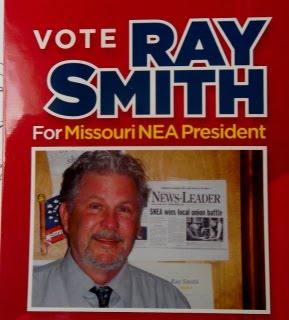
Campaign material paid for by the Committee to Elect Ray Smith - Michelle Shepard, Treasurer.
Tuesday, June 26, 2012

Friday, June 1, 2012
FAQ: Why Are You Running for MNEA President?
Why Are You Running?
It's a great question, maybe the essential question in any campaign. Why are you running? Are you nuts? That second question is one I ask myself occasionally, but it's only rhetorical - probably more of a recognition that this would be a very challenging time to lead any NEA state affiliate. The economics and politics are all wrong. I hope this doesn't come as a news flash to anyone. We, as teachers and education professionals, are most assuredly not in a warm and fuzzy place regarding our standing as professionals and child advocates.
Political Parlor Games
As a union, we expect to have opponents now and then. In Springfield, we battled for three years before finally establishing collective bargaining with our district. Sometimes it was hard to tell who was our greater opponent, a recalcitrant district interested in maintaining the status quo, or the competing association that busied itself spreading misinformation in order to fend off an election loss. In effect, this particular opponent emphasized not losing over actually having a plan for what they would do if they were to win.
But if we have opponents at the local and state level, I don't think it's a stretch to say that we have some full-blown enemies in the political arena. That, in my view, is what makes the next few years such a crucial time for education professionals, students and our association. Education professionals have always been, and will always be, great advocates for children. Now, we find ourselves in a position where we must be strong and forceful advocates for public education on a much larger scale.
After all, taking political potshots at pubic schools and teachers has become a perverse parlor game in some political circles. Teachers, the most underpaid of professionals, have been cast as "government employees" living off the public dole. Political leaders and financiers, through cleverly named PACs, have created a virtual cottage industry producing propaganda bent on persuading the American public that their schools are failing miserably. Bad teachers are the problem, they say, while blithely ignoring the rapid and vast spread of child poverty. One only needs to look to other Midwestern states like Wisconsin, Ohio and Indiana to see how these politics of division have affected public education. In Missouri, it seems we're always just one election away from joining them.
The Community
So, I've painted a pretty gloomy picture, right? Who in their right mind would want to enter this mess, this political fray? Well, you would, for one - along with parents, community leaders, your colleagues, the custodial staff, food service workers, school secretaries, school nurses, bus drivers - and in many cases, your own school administrators and school board members. Schools are, after all, not merely just a reflection of the community. Schools are the community.
There are a lot of great things happening in our schools, and there are a lot of people working very hard to promote innovation and improvements. Together, while we may not have Rex's billions or Rhee's PAC sugar daddies, we are the people who work with the children, know the parents, set the high standards and understand what it means to contribute to successful schools. We will make the fight worthwhile by continuing to work toward our own high standards and by joining together to be vigilant - and to refuse to stand by quietly while political hacks attempt to dabble in what they loosely call "school reform". We clearly have the numbers, but do we have the will to be strong and meet these challenges head on? Yes, we do, and I would be honored to be a leader in this unified effort - and there is my main reason for running.
It's a great question, maybe the essential question in any campaign. Why are you running? Are you nuts? That second question is one I ask myself occasionally, but it's only rhetorical - probably more of a recognition that this would be a very challenging time to lead any NEA state affiliate. The economics and politics are all wrong. I hope this doesn't come as a news flash to anyone. We, as teachers and education professionals, are most assuredly not in a warm and fuzzy place regarding our standing as professionals and child advocates.
Political Parlor Games
As a union, we expect to have opponents now and then. In Springfield, we battled for three years before finally establishing collective bargaining with our district. Sometimes it was hard to tell who was our greater opponent, a recalcitrant district interested in maintaining the status quo, or the competing association that busied itself spreading misinformation in order to fend off an election loss. In effect, this particular opponent emphasized not losing over actually having a plan for what they would do if they were to win.
But if we have opponents at the local and state level, I don't think it's a stretch to say that we have some full-blown enemies in the political arena. That, in my view, is what makes the next few years such a crucial time for education professionals, students and our association. Education professionals have always been, and will always be, great advocates for children. Now, we find ourselves in a position where we must be strong and forceful advocates for public education on a much larger scale.
After all, taking political potshots at pubic schools and teachers has become a perverse parlor game in some political circles. Teachers, the most underpaid of professionals, have been cast as "government employees" living off the public dole. Political leaders and financiers, through cleverly named PACs, have created a virtual cottage industry producing propaganda bent on persuading the American public that their schools are failing miserably. Bad teachers are the problem, they say, while blithely ignoring the rapid and vast spread of child poverty. One only needs to look to other Midwestern states like Wisconsin, Ohio and Indiana to see how these politics of division have affected public education. In Missouri, it seems we're always just one election away from joining them.
The Community
So, I've painted a pretty gloomy picture, right? Who in their right mind would want to enter this mess, this political fray? Well, you would, for one - along with parents, community leaders, your colleagues, the custodial staff, food service workers, school secretaries, school nurses, bus drivers - and in many cases, your own school administrators and school board members. Schools are, after all, not merely just a reflection of the community. Schools are the community.
There are a lot of great things happening in our schools, and there are a lot of people working very hard to promote innovation and improvements. Together, while we may not have Rex's billions or Rhee's PAC sugar daddies, we are the people who work with the children, know the parents, set the high standards and understand what it means to contribute to successful schools. We will make the fight worthwhile by continuing to work toward our own high standards and by joining together to be vigilant - and to refuse to stand by quietly while political hacks attempt to dabble in what they loosely call "school reform". We clearly have the numbers, but do we have the will to be strong and meet these challenges head on? Yes, we do, and I would be honored to be a leader in this unified effort - and there is my main reason for running.
Subscribe to:
Comments (Atom)