Leaving Behind No Child Left Behind . . . Finally
Every school year brings its share of changes that affect education professionals, and 2012-13 rolls in with a fundamental shift away from some of the more damaging affects of the federal education law known as No Child Left Behind.
It should be noted that NEA lobbied the Obama Administration and was a key player in establishing language and key provisions in the waiver. It's far from perfect, but as the saying goes, "If you're not at the table, you could end up on the menu." There is no question that the provisions of the waiver are an improvement over the draconian measures that came with No Child Left Behind, but there is still much work to be done in monitoring and shaping how the waiver affects educators at all levels.
Springfield NEA, Missouri NEA and SPS administration were active participants in numerous MSIP5 developmental meetings over the past year and helped shape MSIP5 and Missouri's waiver application.
Missouri Granted ESEA Flexibility Waiver
On June 27, 2012, the Department of Education granted a waiver to Missouri regarding No Child Left Behind (formerly known as Elementary and Secondary Education Act). The Obama administration had placed a deadline for Congress to change and re-authorize the law, but - surprise!- nothing was done. So, an executive order was issued, and now over half the states have been granted waivers after submitting their plans to the Department of Education.
The ESEA Waiver was granted based on these required principles:
1) Adopt College and Career Ready Standards
2) State-developed differentiated recognition, accountability and support for school districts (MSIP5)
3) Develop and adopt guidelines for local teacher evaluation and support systems (Missouri Model Educator Evaluation), which will be piloted for 2 years, full implementation by 2014-15. Springfield is one of the pilot districts for new teacher evaluations this year. Springfield NEA will be collaborating with the district in developing this pilot evaluation and support system, which also includes an evaluation process for principles and the superintendent.
Here is a brief summary of some basic changes that come with the ESEA Waiver:
- Missouri schools will no longer be expected to reach 100% student proficiency goal by 2014.
- District are no longer required to reserve 20% of Title funds for Supplemental Education Services and school choice transportation.
- No more labeling of schools as "failing", no more letters sent to parents explaining that their child is attending a failing school.
- Schools missing one target will no longer be equated with schools missing several targets.
- Status of MAP scores no longer make up 100% of scoring measure.
- The "highly qualified teachers" component remains, but district penalty has been removed.
- Federal and State standards are not in conflict.
- The focus moves from punitive labeling to support for continuous improvement.
Instead of relying 100% on MAP status (advanced, proficient . . . etc.) as the lone criteria determining ranking of schools, MAP scores will be figured three ways: Status, Growth and Progress.
Status - This is pretty much the same old MAP snapshot approach we've come to know and love, but districts will also be able to use either Growth or Progress (whichever is more favorable) as a second measure that combines with Status to determine an overall score.
Growth - This factor compares the level of individual student growth (individual growth from last year's 3rd grade to this year's 4th grade).
Progress - This would compare grade level scores (how did this year's 4th graders compare with last year's 4th graders).
Based on a rather elaborate scoring system using a combination of the above, highest performing schools will be designated as Reward Schools (not sure of reward, but rest assured it won't be $). Lowest performing schools will be either Focus Schools or Priority Schools. There will be no penalty for schools that fall into these lower categories, but they will be the recipients of some kind of DESE oversite. And it remains to be seen how DESE will handle the increased work load in tracking over 500 districts, given the fact that budget cuts have rendered the state agency with what amounts to a skeleton staff.
Teacher Evaluation
The Missouri Model establishes four performance levels: New, Developing, Proficient, Distinguished. The model stresses that student performance must be included as a part of the evaluative process, but districts are provided flexibility in determining how this is done. This is why it is so important for the teachers to be at the table as this new system is formed, and that's why Springfield NEA has already met with district administrators to establish this precedent in the early stages. Springfield NEA will either issue our own surveys or work with the district to gather information from teachers regarding what they view as important measures - especially regarding student performance.
Missouri NEA has already worked with DESE to help "broaden" language regarding student achievement that was sent with the original waiver request. Missouri NEA also advocated against a state-determined weight of student performance - now it is a local decision. Springfield NEA, representing over 900 members in our district, will be an active participant in shaping the new system of evaluating educators at all levels.
Again, there is no additional funding from the feds or the state for the considerable amount of time and effort it will take for districts to establish these new evaluation systems.
Up Next
Up Next . . . feedback from teachers on the Springfield Learning Model, more information on Common Core State Standards, which take effect in 2014, and discussion on how the district determines "critical needs" when establishing budget priorities. Thanks for the wonderful work you do with students and for your support for Springfield NEA . . . it's completely mutual!
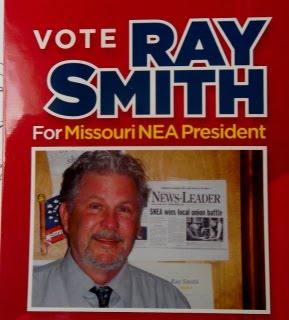
Ray Smith, President
Springfield NEA
