It's been over a month since I posted anything here, but I've enjoyed doing a little traveling across the state meeting some folks and attending various legislative functions and meetings. Here in Springfield, we're in the middle of negotiating three separate contracts for 1,800 teachers, 55 school nurses and over 200 clerical staff, respectively. This is a daunting task to say the least.
Be Careful What You Wish For
"Be careful what you wish for." I distinctly remember our district's former CFO cautioning me after a particularly contentious school board meeting back in 2008. In some respects, she was right. Achieving bargaining rights and winning three representation elections was at once a grueling and energizing process. Our local membership had never been more engaged. But we always knew that any election successes would be soon forgotten if we weren't able to negotiate tangible, positive changes in the working/learning environment for the folks we sought to represent.
That's what we're doing now, and it takes every bit as much focus and determination as any election campaign. One huge change here in Springfield has been how our district now approaches the bargaining process. Of course, the initial reaction was, "No Thanks, we're representing you just fine," and other, even more patronizing quotes during board debate.
How Administrators View Collective Bargaining
After three years of negotiations for multiple bargaining units, the district now fully embraces the process. The school board openly talks about collective bargaining from the dais, and the Human Resources Department now provides a power point to new hires that describes representation and the process of bargaining. A couple of months ago, the Columbia district sent a contingent of administrators down to Springfield to confer with our HR director and school attorney about the bargaining process. CMNEA had just won the rep election, and the admins wanted some guidelines on setting up parameters for bargaining. The district invited me to attend the session, and it was gratifying to hear our HR director describe how positive the process had become, how they had learned more about employee working conditions and developed a good working relationship with Springfield NEA.
Man, I didn't think we'd ever hear language like that. And I'm here to tell you that it took a great deal of work and straight communication to get to that point in time - on our part and on the part of the district. Now, the real work has begun. It doesn't get any easier, but it sure is gratifying when a particular proposal is adopted into the contract - positive changes that the teachers/nurses/secretaries know came directly from them.
Time Well Spent
So, that's where a bunch of our energy is focused right now. Our bargaining teams meet as often as possible after work. We put together proposals and counter-proposal, go over language incessantly, come up with new language, and try to reach tentative agreements that our hard working education professionals will recognize as a step forward. I can tell you it's time well spent - and that's a good description of how we feel at the end of the process . . . spent.
The campaign for MNEA president has seemed a bit like a break from work in some respects. But I do know that - just as with the collective bargaining process - the real work begins after the election . . . and there are some major issues facing teachers and education professionals in our state and nation that will require great focus and hard work.
I'm looking forward to seeing everybody at the RA. Please come by our hospitality rooms (we've expanded) that are jointly sponsored by six candidates. Even in our respective campaigns, we've shown a great deal of collaboration and cooperation, which bodes well for the leadership of our association.
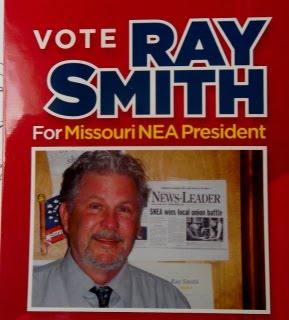
Campaign material paid for by the Committee to Elect Ray Smith - Michelle Shepard, Treasurer.

No comments:
Post a Comment